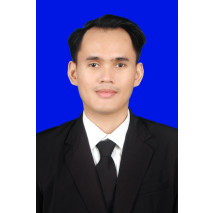
Saya memperoleh IPK sempurna 4,00 sebagai lulusan teknik informatika dari Universitas Udayana. Saya aktif melakukan penelitian selama masa studi, menerbitkan artikel ilmiah, bekerja sebagai asisten dosen, dan magang sebagai data scientist dan machine learning engineer. Di Institut Teknologi Sepuluh Nopember, saya juga memperoleh gelar master di bidang teknik informatika dengan konsentrasi pada kecerdasan komputasional, deep learning, machine learning, dan natural language processing. Kemajuan teknologi AI, machine learning, data science, dan swarm intelligence merupakan fokus utama minat saya. Saya telah menerbitkan beberapa makalah di jurnal internasional dengan indeks SINTA 2 dan 3, konferensi internasional dengan indeks Scopus (IEEE dan Springer), dan konferensi internasional dengan indeks Q2 dan Q3. Keahlian akademis saya telah ditingkatkan oleh pengalaman langsung saya sebagai machine learning engineer di perusahaan startup edutech. Saya mahir dalam Python, Django, Flask, MySQL, dan PHP. Saya adalah individu dengan antusiasme tinggi untuk belajar, tanggung jawab, dan dapat dipercaya. Saya siap untuk mengejar karir sebagai machine learning engineer dan programmer python
satriabimantara (satriabimantara)
Python MySQL PHP Django Framework Microsoft Office HTML Flask Python Bootstrap Machine Learning Artificial Intelligence
Make a Private Project
Invite to Bid
Existing Projects
| User Name: | satriabimantara |
| Account Type: | Personal Account |
| Date Registered: | 27/02/2024 11:03:08 WIB |
| Last Seen: | 07/03/2025 15:01:46 WIB |
| Provinsi: | Bali |
| Kabupaten: | Kota Denpasar |
| Website: | https://github.com/satriabimantara |
| Online Hours: | 2.11 |
| Projects Won: | 0 |
| Projects Completed: | 0 |
| Completion Rate | - |
| Projects Arbitrated: | 0 |
| Arbitration Rate | - |
| Current Projects: | 0 |
Ratings & Rankings

0.00/10.00
0 Point
No Ranking
0 Projects
0.00/10.00
0 Point
No Ranking
0 Projects
0.00/10.00
0 Point
No Ranking
0 Sales
0.00/10.00
0 Point
No Ranking
0 Users
Services
No record found.
Products
No record found.
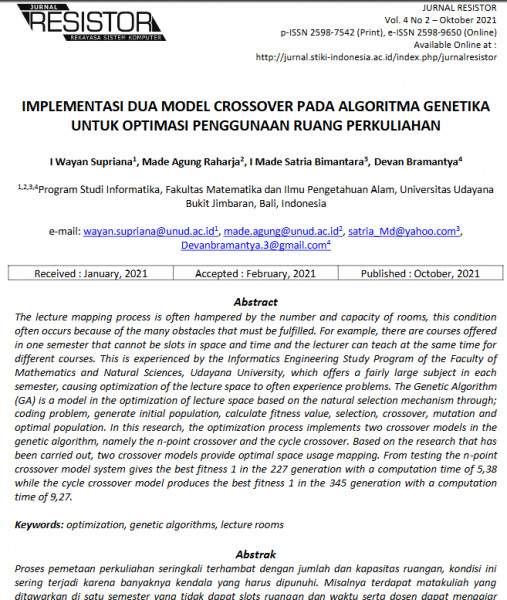
2021: "IMPLEMENTASI DUA MODEL CROSSOVER PADA ALGORITMA GENETIKA UNTUK OPTIMASI PENGGUNAAN RUANG PERKULIAHAN"
The lecture mapping process is often hampered by the number and capacity of rooms, this condition often occurs because of the many obstacles that must be fulfilled. For example, there are courses offered in one semester that cannot be slots in space and time and the lecturer can teach at the same time for different courses. This is experienced by the Informatics Engineering Study Program of the Faculty of Mathematics and Natural Sciences, Udayana University, which offers a fairly large subject in each semester, causing optimization of the lecture space to often experience problems. The Genetic Algorithm (GA) is a model in the optimization of lecture space based on the natural selection mechanism through; coding problem, generate initial population, calculate fitness value, selection, crossover, mutation and optimal population. In this research, the optimization process implements two crossover models in the genetic algorithm, namely the n-point crossover and the cycle crossover. Based on the research that has been carried out, two crossover models provide optimal space usage mapping. From testing the n-point crossover model system gives the best fitness 1 in the 361 generation with a computation time of 11.08 while the cycle crossover model produces the best fitness 1 in the 361 generation with a computation time of 15.08.
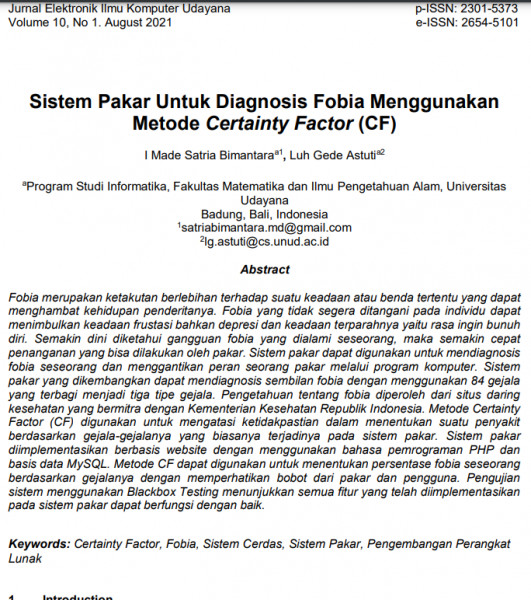
2021: "Sistem Pakar Untuk Diagnosis Fobia Menggunakan Metode Certainty Factor (CF)"
Fobia merupakan ketakutan berlebihan terhadap suatu keadaan atau benda tertentu yang dapat menghambat kehidupan penderitanya. Fobia yang tidak segera ditangani pada individu dapat menimbulkan keadaan frustasi bahkan depresi dan keadaan terparahnya yaitu rasa ingin bunuh diri. Semakin dini diketahui gangguan fobia yang dialami seseorang, maka semakin cepat penanganan yang bisa dilakukan oleh pakar. Sistem pakar dapat digunakan untuk mendiagnosis fobia seseorang dan menggantikan peran seorang pakar melalui program komputer. Sistem pakar yang dikembangkan dapat mendiagnosis sembilan fobia dengan menggunakan 84 gejala yang terbagi menjadi tiga tipe gejala. Pengetahuan tentang fobia diperoleh dari situs daring kesehatan yang bermitra dengan Kementerian Kesehatan Republik Indonesia. Metode Certainty Factor (CF) digunakan untuk mengatasi ketidakpastian dalam menentukan suatu penyakit berdasarkan gejala-gejalanya yang biasanya terjadinya pada sistem pakar. Sistem pakar diimplementasikan berbasis website dengan menggunakan bahasa pemrograman PHP dan basis data MySQL. Metode CF dapat digunakan untuk menentukan persentase fobia seseorang berdasarkan gejalanya dengan memperhatikan bobot dari pakar dan pengguna. Pengujian sistem menggunakan Blackbox Testing menunjukkan semua fitur yang telah diimplementasikan pada sistem pakar dapat berfungsi dengan baik.
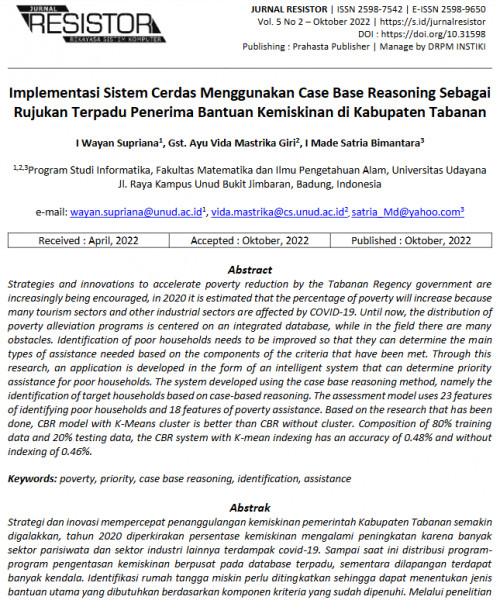
2022: "Implementasi Sistem Cerdas Menggunakan Case Base Reasoning Sebagai Rujukan Terpadu Penerima Bantuan Kemiskinan di Kabupaten Tabanan"
Strategi dan inovasi mempercepat penanggulangan kemiskinan pemerintah Kabupaten Tabanan semakin digalakkan, tahun 2020 diperkirakan persentase kemiskinan mengalami peningkatan karena banyak sektor parisiwata dan sektor industri lainnya terdampak covid-19. Sampai saat ini distribusi program-program pengentasan kemiskinan berpusat pada database terpadu, sementara dilapangan terdapat banyak kendala. Identifikasi rumah tangga miskin perlu ditingkatkan sehingga dapat menentukan jenis bantuan utama yang dibutuhkan berdasarkan komponen kriteria yang sudah dipenuhi. Melalui penelitian ini dikembangkan aplikasi berupa sistem cerdas yang dapat menentukan bantuan prioritas rumah tangga miskin. Sistem yang dikembangkan menggunakan metode case base reasoning yaitu identifikasi rumah tangga sasaran didasari oleh penalaran berbasis kasus. Model penilaian menggunakan 23 fitur identifikasi rumah tangga miskin dan 18 fitur bantuan kemiskinan. Berdasarkan penelitian yang sudah dilakukan, model CBR dengan kluster K-Means lebih baik dibandingkan CBR tanpa kluster. Komposisi data training 80% dan data testing 20%, sistem CBR dengan indexing K-mean memiliki akurasi sebesar 0.48% dan tanpa indexing sebesar 0.46%
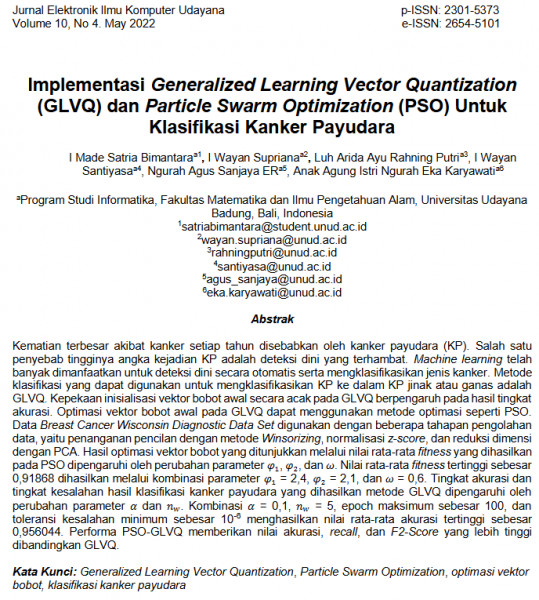
2022: "Implementasi Generalized Learning Vector Quantization (GLVQ) dan Particle Swarm Optimization (PSO) Untuk Klasifikasi Kanker Payudara"
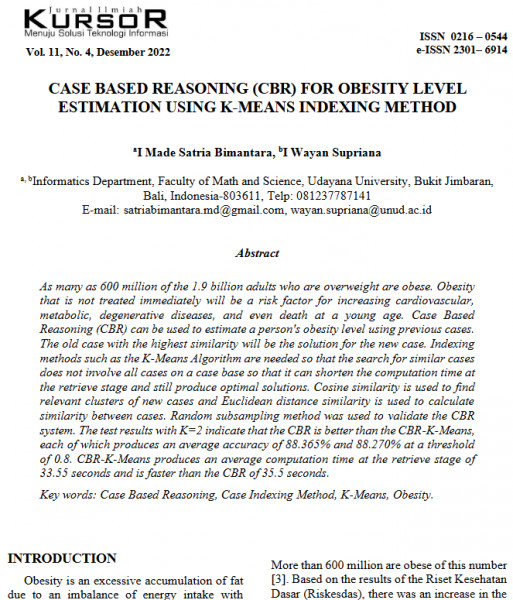
2022: "CASE BASED REASONING (CBR) FOR OBESITY LEVEL ESTIMATION USING K-MEANS INDEXING METHOD"
As many as 600 million of the 1.9 billion adults who are overweight are obese. Obesity that is not treated immediately will be a risk factor for increasing cardiovascular, metabolic, degenerative diseases, and even death at a young age. Case Based Reasoning (CBR) can be used to estimate a person's obesity level using previous cases. The old case with the highest similarity will be the solution for the new case. Indexing methods such as the K-Means Algorithm are needed so that the search for similar cases does not involve all cases on a case base so that it can shorten the computation time at the retrieve stage and still produce optimal solutions. Cosine similarity is used to find relevant clusters of new cases and Euclidean distance similarity is used to calculate similarity between cases. Random subsampling method was used to validate the CBR system. The test results with K=2 indicate that the CBR is better than the CBR-K-Means, each of which produces an average accuracy of 88.365% and 88.270% at a threshold of 0.8. CBR-K-Means produces an average computation time at the retrieve stage of 33.55 seconds and is faster than the CBR of 35.5 seconds.
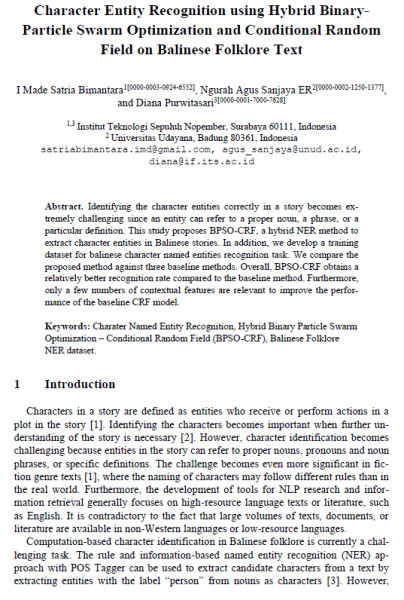
2023: "Character Entity Recognition Using Hybrid Binary-Particle Swarm Optimization and Conditional Random Field on Balinese Folklore Text"
Identifying the character entities correctly in a story becomes extremely challenging since an entity can refer to a proper noun, a phrase, or a particular definition. This study proposes BPSO-CRF, a hybrid NER method to extract character entities in Balinese stories. In addition, we develop a training dataset for balinese character named entities recognition task. We compare the proposed method against three baseline methods. Overall, BPSO-CRF obtains a relatively better recognition rate compared to the baseline method. Furthermore, only a few numbers of contextual features are relevant to improve the performance of the baseline CRF model.
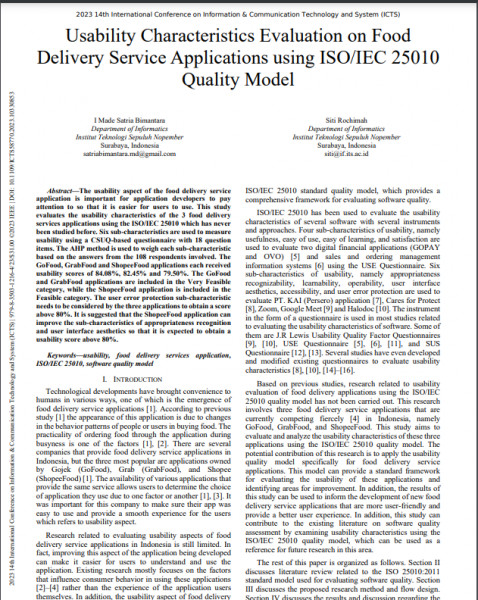
2023: "Usability Characteristics Evaluation on Food Delivery Service Applications using ISO/IEC 25010 Quality Model"
The usability aspect of the food delivery service application is important for application developers to pay attention to so that it is easier for users to use. This study evaluates the usability characteristics of the 3 food delivery services applications using the ISO/IEC 25010 which has never been studied before. Six sub-characteristics are used to measure usability using a CSUQ-based questionnaire with 18 question items. The AHP method is used to weigh each sub-characteristic based on the answers from the 108 respondents involved. The GoFood, GrabFood and ShopeeFood applications each received usability scores of 84.08%, 82.45% and 79.50%. The GoFood and GrabFood applications are included in the Very Feasible category, while the ShopeeFood application is included in the Feasible category. The user error protection sub-characteristic needs to be considered by the three applications to obtain a score above 80%. It is suggested that the ShopeeFood application can improve the sub-characteristics of appropriateness recognition and user interface aesthetics so that it is expected to obtain a usability score above 80%.

2023: "Multilevel Thresholding of Color Image Segmentation Using Memory-based Grey Wolf Optimizer With Otsu Method, Kapur, and M.Masi Entropy"
Determining the optimal threshold value for image segmentation has become more attention in recent years because of its varied uses. Otsu-based thresholding methods, minimum cross entropy, and Kapur entropy are efficient for solving bi-level thresholding image segmentation problems (BL-ISP), but not with multi-level thresholding image segmentation problems (ML-ISP). The main problem is exponentially increasing computational complexity. This study uses the memory-based Gray Wolf Optimizer (mGWO) to determine the optimal threshold value for solving ML-ISP on RGB images. The mGWO method is a variant of the standard grey wolf optimizer (GWO) that utilizes the best track record of each individual grey wolf for the global exploration and local exploitation phases of the problem solution space. The solution candidates are represented by each grey wolf using the image intensity values and optimized according to mGWO characteristics. Three objective functions, namely the Otsu method, Kapur Entropy, and M.Masi Entropy are used to evaluate the solutions generated in the optimization process. The GridSearch method is used to determine the optimal parameter combination of each method based on 10 training images. Evaluation of the performance of the mGWO method was measured using several benchmark images and compared with five standard swarm intelligence (SI) methods as benchmarks. Analysis of the results was carried out qualitatively and quantitatively based on the average PSNR, RMSE, SSIM, UQI, fitness value, and CPU processing time from 30 tests. The results were analyzed further with the Wilcoxon signed-rank test. The experimental results show that the performance of the mGWO method outperforms the benchmark method in most experiments and metrics. The mGWO variant also proved to be superior to the standard GWO in resolving multi-level color image segmentation problems. The mGWO performance results are also compared with other state-of-the-art SI methods in solving ML-ISP on grayscale images and was able to outperform those methods in most experiments.
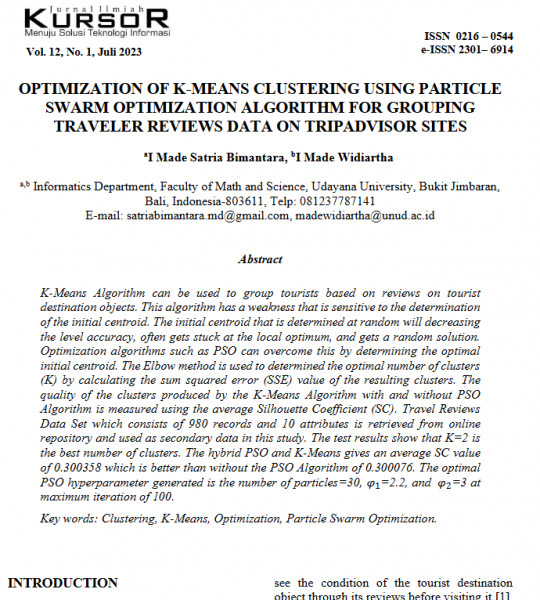
2023: "OPTIMIZATION OF K-MEANS CLUSTERING USING PARTICLE SWARM OPTIMIZATION ALGORITHM FOR GROUPING TRAVELER REVIEWS DATA ON TRIPADVISOR SITES"
K-Means Algorithm can be used to group tourists based on reviews on tourist destination objects. This algorithm has a weakness that is sensitive to the determination of the initial centroid. The initial centroid that is determined at random will decreasing the level accuracy, often gets stuck at the local optimum, and gets a random solution. Optimization algorithms such as PSO can overcome this by determining the optimal initial centroid. The optimal number of clusters (K) will be determined using the Elbow method by calculating the SSE value of the resulting cluster. The average Silhouette Coefficient (SC) is used to measure the quality of the clusters produced by the K-Means Algorithm with and without the PSO Algorithm. This study uses secondary data obtained from the UCI Machine Learning Repository with the name Travel Reviews Data Set which consists of 980 records and 10 attributes. The test results show that K=2 is the optimal number of clusters. The K-Means and PSO Algorithm gives an average SC value of 0.300358 which is better than without the PSO Algorithm of 0.300076. The optimal PSO hyperparameter generated is the number of particles=30, \varphi_1=2.2, and {\ \varphi}_2=3 at maximum iteration of 100.
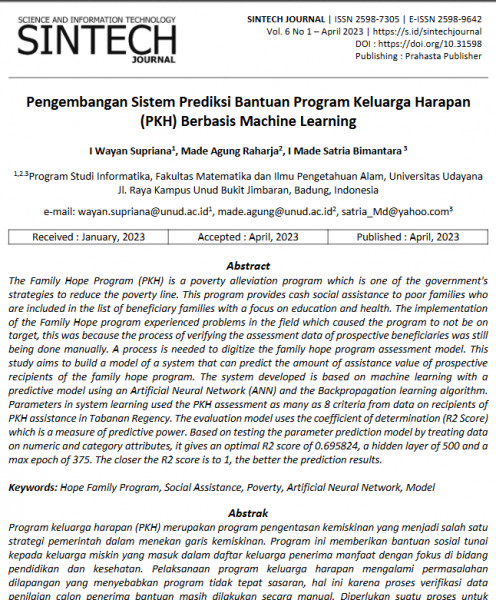
2023: "Pengembangan Sistem Prediksi Bantuan Program Keluarga Harapan (PKH) Berbasis Machine Learning"
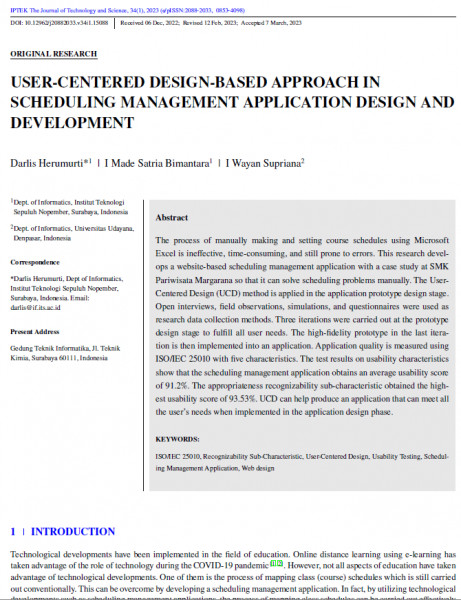
2023: "User-Centered Design-Based Approach in Scheduling Management Application Design and Development"
The process of manually making and setting course schedules using Microsoft Excel is ineffective, time-consuming, and still prone to errors. This research develops a website-based scheduling management application with a case study at SMK Pariwisata Margarana so that it can solve scheduling problems manually. The UserCentered Design (UCD) method is applied in the application prototype design stage. Open interviews, field observations, simulations, and questionnaires were used as research data collection methods. Three iterations were carried out at the prototype design stage to fulfill all user needs. The high-fidelity prototype in the last iteration is then implemented into an application. Application quality is measured using ISO/IEC 25010 with five characteristics. The test results on usability characteristics show that the scheduling management application obtains an average usability score of 91.2%. The appropriateness recognizability sub-characteristic obtained the highest usability score of 93.53%. UCD can help produce an application that can meet all the user’s needs when implemented in the application design phase.
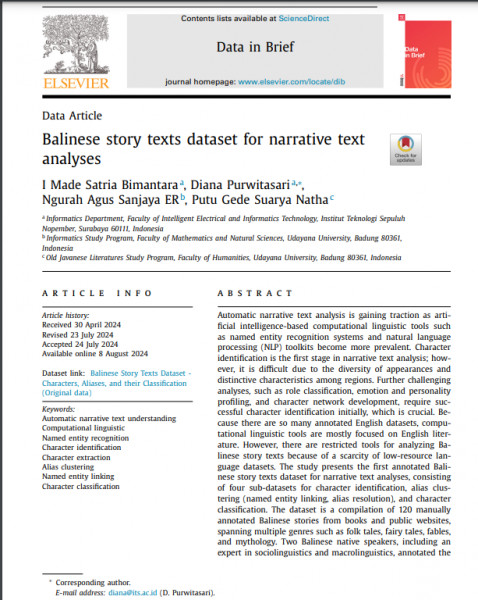
2024: "Balinese story texts dataset for narrative text analyses"
Automatic narrative text analysis is gaining traction as artificial intelligence-based computational linguistic tools such as named entity recognition systems and natural language processing (NLP) toolkits become more prevalent. Character identification is the first stage in narrative text analysis; however, it is difficult due to the diversity of appearances and distinctive characteristics among regions. Further challenging analyses, such as role classification, emotion and personality profiling, and character network development, require successful character identification initially, which is crucial. Because there are so many annotated English datasets, computational linguistic tools are mostly focused on English literature. However, there are restricted tools for analyzing Balinese story texts because of a scarcity of low-resource language datasets. The study presents the first annotated Balinese story texts dataset for narrative text analyses, consisting of four sub-datasets for character identification, alias clustering (named entity linking, alias resolution), and character classification. The dataset is a compilation of 120 manually annotated Balinese stories from books and public websites, spanning multiple genres such as folk tales, fairy tales, fables, and mythology. Two Balinese native speakers, including an expert in sociolinguistics and macrolinguistics, annotated the dataset using predetermined guidelines set by an expert. The inter-annotator agreement (IAA) score is calculated using Cohen's Kappa Coefficient, Jaccard Similarity Coefficient, Mean F1-score to measure the level of agreement between annotators and dataset consistency and its reliability. The first subdataset consists of 89,917 annotated words with five labels referring to the Balinese-character named entities. Each character entity's appearance in 6,634 sentences is further annotated in the second subdataset. These two sub-datasets can be used for character identification purposes at the word and sentence level. The list of character groups which are groups of various aliases for each character entity has been annotated in the third subdataset for alias clustering purposes. The third subdataset contains 930-character groups from 120 story texts with each story text containing an average of 7-to-8-character groups. In the fourth subdataset, 848-character groups—of the 930-character groups in the third subdataset—have been categorized as protagonists and antagonists. The protagonists (66.16 %) make up most character groups, with the antagonists (33.84 %) making up the rest of the groups. The fourth subdataset can be used for computing-based classification of characters into two roles between protagonist and antagonist. These datasets have the potential to improve research in narrative text analyses, especially in the areas of computational linguistic tools and advanced machine learning (ML) and deep learning (DL) models in low resource languages. It can also be used for further research including character network development, character relationship extraction, and character classification beyond protagonist and antagonist.
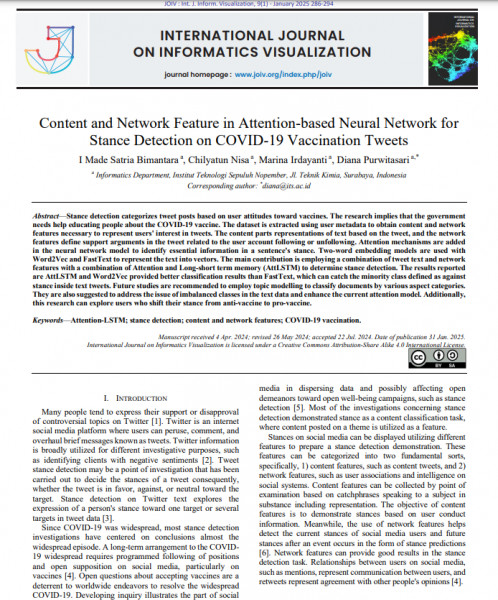
2025: Stance detection in COVID-19 vaccination utilizing tweets is crucial for several reasons, such as public health communication, monitoring vaccine sentiment, and identifying misinformation. This research aims to explore the use of attention-based neural networks for stance detection in Indonesian COVID-19 vaccination tweets. The research focuses on enhancing accuracy by integrating content and network features. The content features represent the tweet's text, while network features define the user account's following or unfollowing. The primary contribution of this research is the development of an Attention Long Short-Term Memory (AttLSTM) model for stance detection in Indonesian tweets related to the COVID-19 vaccination. This model combines content and network features to improve accuracy in classifying user attitudes. We also highlight the performance differences between Word2Vec and FastText for numerical text representation in the AttLSTM model. The research used the Indonesian COVID-19 vaccination-related tweet dataset from prior research. The dataset is extracted using user metadata to obtain content and network features necessary to represent users' interest in tweets. Our research method involves data preparation, preprocessing, extraction of content and network features, and the development of an AttLSTM model. By integrating content and network features into the AttLSTM model with Word2Vec text representation, the study demonstrates superior performance compared to the LSTM baseline model and FastText. Adding attention mechanisms to the baseline LSTM model can capture crucial information, such as the minority class inside a tweet's text. Future research will involve exploring advanced data processing methods and ensemble learning techniques to further improve the model's performance.
No record found.
No record found.
Anda harus login terlebih dahulu untuk melihat data ini.
You must login first to see this data.
 Loading ...